EU Data Act National Implementation Overview: Which EU Countries already adopted Enforcement Laws?

The EU Data Act has already been directly applicable across the European Union since September 2025.
However, many companies are still asking an important question:
How far have EU Member States actually progressed with national enforcement and implementation structures?
This question is becoming increasingly relevant.
Several countries have now started adopting national laws that define competent authorities, penalties, enforcement pathways, and procedural rules around the EU Data Act.
Germany recently joined this group after the German Bundestag passed its national implementation law.
We analyzed the current implementation status across the European Union.
The map below illustrates the current level of national implementation maturity across the European Union.
Why national implementation matters
A common misconception is that national implementation laws are not important because the EU Data Act is already directly applicable.
Legally speaking, the regulation indeed already applies across all Member States.
However, the regulation still requires countries to establish national enforcement structures.
This includes:
- competent authorities
- penalty frameworks
- complaint procedures
- dispute resolution mechanisms
- national coordination structures
In practice, these laws significantly increase legal certainty around how Data Act rights can actually be enforced.
This changes the regulatory landscape for companies operating connected products and digital services.
Current implementation status across the EU
The current implementation landscape across Europe is highly fragmented.
Some countries already adopted national implementation laws, while others are still in proposal stages or have not yet published visible legislative drafts.
This creates a situation where the EU Data Act already applies everywhere, but the practical maturity of enforcement structures differs significantly between Member States.
For companies operating across multiple EU markets, this fragmentation creates additional uncertainty around enforcement expectations, timelines, and operational readiness.
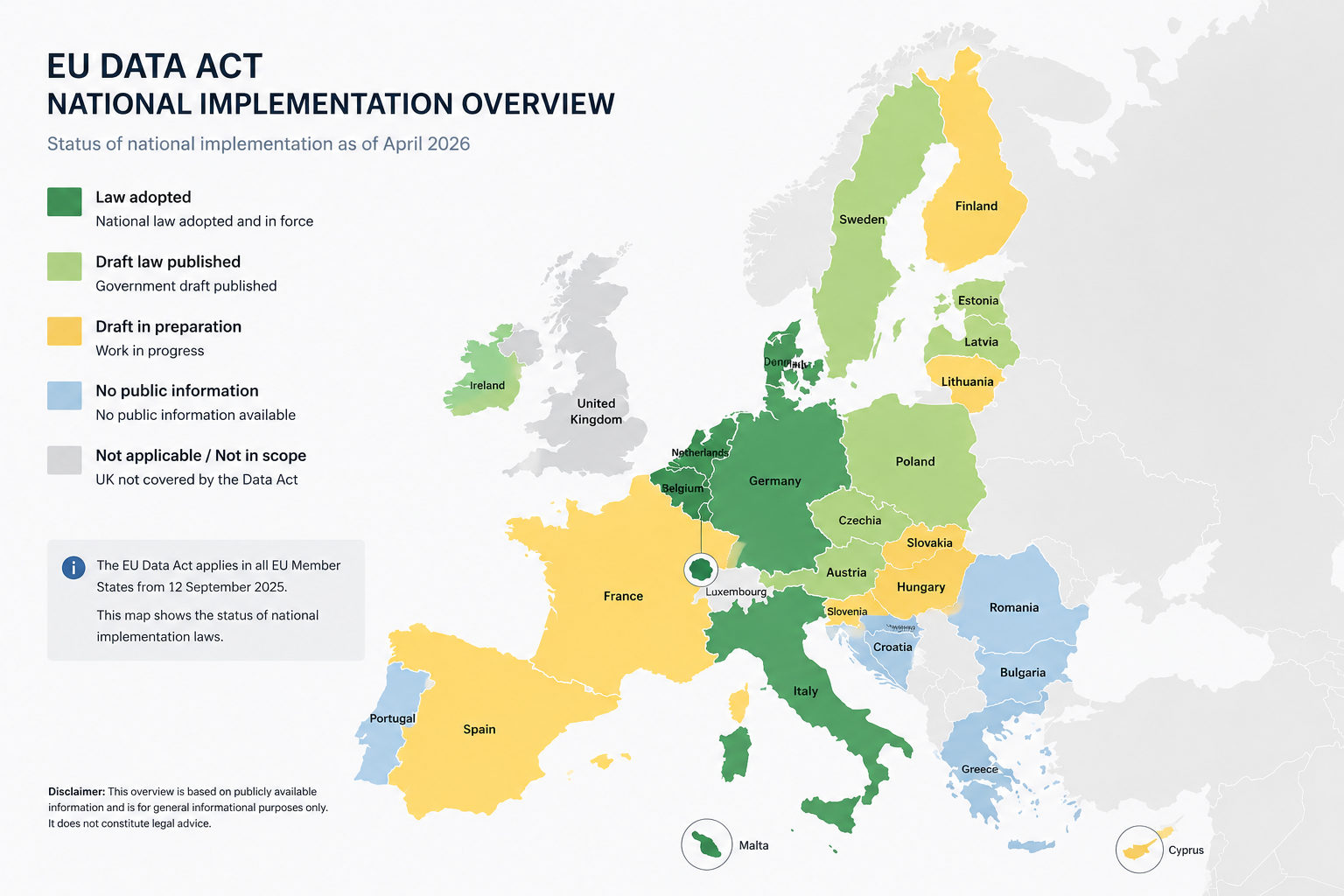
Current implementation maturity of national EU Data Act enforcement structures across EU Member States as of March 2026.
The overview can roughly be grouped into four categories:
- countries with adopted implementation laws
- countries with active legislative processes
- countries with partial implementation or designated authorities
- countries with limited visible implementation progress
Countries with adopted implementation laws
The following countries have already adopted national implementation laws or equivalent enforcement legislation:
- Denmark
- Finland
- Malta
- Netherlands
Germany recently moved into the group of advanced implementation countries after the Bundestag passed the German implementation law.
Countries with ongoing legislative processes
Several countries already published drafts, proposals, or legislative frameworks:
- Czech Republic
- Ireland
- Poland
- Slovakia
These countries are actively progressing towards more operational enforcement structures.
Countries with partial implementation or designated authorities
Some Member States already designated authorities or implemented partial enforcement structures without a fully completed implementation law.
Examples include:
- France
- Latvia
- Sweden
- Romania
- Croatia
- Cyprus
Countries with limited visible progress
Several Member States have not yet published major visible implementation drafts.
Examples currently include:
- Austria
- Belgium
- Bulgaria
- Estonia
- Greece
- Hungary
- Italy
- Lithuania
- Luxembourg
- Portugal
- Slovenia
- Spain
This does not mean the EU Data Act does not apply in these countries.
It simply means the level of operational enforcement maturity and legal certainty currently differs across Europe.
Why this matters for manufacturers and IoT companies
For manufacturers of connected products, the fragmentation creates a difficult situation.
Many companies operate across multiple EU countries while simultaneously facing:
- different implementation timelines
- different enforcement maturity levels
- evolving authority structures
- varying levels of market awareness
At the same time, the underlying Data Act obligations already apply EU-wide.
This means organizations cannot realistically wait until every Member State fully finalizes implementation.
The real challenge is technical readiness
In many cases, the biggest challenge is not legal interpretation.
It is technical implementation.
Typical challenges include:
- exposing secure APIs
- user authentication and authorization
- device ownership management
- onboarding and offboarding processes
- real-time data sharing
- third-party data access
- consent management
- scalable access control
- audit logging and traceability
- cloud portability and interoperability
This is especially difficult for manufacturers that historically never designed products for user-level external data access.
What companies should expect next
Over the coming months, more Member States are expected to:
- adopt implementation laws
- designate competent authorities
- publish guidance
- define enforcement procedures
- clarify penalties
This will likely increase market awareness significantly.
Many companies that previously delayed implementation efforts may suddenly face increasing pressure from:
- customers
- business partners
- legal departments
- procurement teams
- regulators
Germany may become an important signal for the rest of Europe
Germany is one of Europe’s largest industrial and manufacturing markets.
As German enforcement structures become more concrete, many connected product manufacturers across Europe will likely reassess their own implementation timelines.
This is particularly relevant in industries such as:
- industrial machinery
- smart building systems
- automotive
- energy systems
- medical technology
- connected consumer products
- industrial IoT platforms
Final thoughts
The EU Data Act already applies throughout Europe.
However, national implementation laws are increasingly transforming the regulation from a theoretical compliance topic into an operational enforcement reality.
The current implementation landscape across Europe remains fragmented.
Nevertheless, the overall direction is clear.
Member States are gradually building the structures required for practical enforcement.
For companies affected by the EU Data Act, the most important question is no longer whether implementation will eventually become necessary.
The more relevant question is whether the required technical and organizational capabilities will be ready before enforcement pressure significantly increases.
Related article
For more details about Germany’s recently adopted implementation law, see our separate analysis: